Mum & Me, 1954

Mum & Me, 1954
Mum & Me, 1954

Tuesday, May 15, 2012

Dorothy Shiels & Kerry Wright - 1961


Dorothy Shiels & Kerry Wright
1961

Whilst recently conducting a major house clean, I came across this charming photo secreted within the pages of a book in my library. I’d forgotten I had it. It was taken at a family wedding reception at the grand old Australia Hotel (since demolished) in Martin Place, Sydney, in late 1961, just a couple of weeks after my twelfth birthday. With me is my cousin and godmother, Dorothy Cynthia Shiels nee Murrell (b.1923), who is the daughter of my mother’s sister, Gladys Murrell nee Glover. Yep, it’s true, I really do have a godmother named Dorothy. No wisecracks about Fairy Godmothers, please! (wink) It was Dorothy who first took me to the Art Gallery of New South Wales, live theatre and various other assorted museums and galleries around town, here in Sydney. It’s Dorothy I have to thank for awaking in me my enduring love and interest in culture and the arts. My very own Auntie Mame! 


Sunday, May 6, 2012

Possibly Sarah Jane Turner with her youngest daughter, Sarah Anne - ca.1880


Possibly Sarah Jane Turner
with her youngest daughter, Sarah Anne
ca.1880

I came upon this photo only recently amongst my late mother's (Emily Flora Wright nee Glover) personal effects. As with most of the photos in her collection, there's nothing to indicate who these people are. It seems to have been a tradition in my family to never write anything on the back of family photos. For that reason, I don't know for sure who these people are.

Mum's mother, Louise Mary Glover nee Turner was born in 1870, meaning she'd be about the age of this woman around the turn of the century, if that's when this photo was taken. However, as she didn't marry until 1899, it is unlikely to be her, as this appears to be a mother and child study to me.

The fact that the photo was taken at Falcon Studios in North Sydney is an indication that they are from my Mum's side of the family, not Dad's. Louisa Mary's family had a farm at Roseville Chase at that time, near the present Roseville Bridge, not all that far from North Sydney, whereas Dad's family lived far away in the upper Hunter Valley of New South Wales.

My cousin, Dorothy Shiels (b.1923), believes this may be Louisa Mary's mother, my maternal great-grandmother, Sarah Jane Turner nee Senior (1850-1889), with her daughter, Louisa Mary (my grandmother), as a child, meaning it would date from the 1870s.

Confused? Me too!

What Dorothy's hypothesis does not explain, however, is why Louisa Mary was photographed alone with her mother and not with her twin sister, Theresa Jane, also being present. Surely the twins, Louisa and Theresa, would have been photographed together with their mother.

Sarah Jane Turner had two other daughters, Elizabeth Emily (1876-1802) and Sarah Anne (1878-1947), so it may be one of them photographed with their mother.

Sarah Jane predeceased her husband, my maternal great-grandfather, William Turner (1844-1892), in 1889, aged 38. William died only a few years later, in 1892, aged 48.

They left behind six orphan children, the youngest of whom was Sarah Anne, aged just 14 at the time of her father's death.

It seems reasonable to assume that my grandmother, Louisa Mary, the eldest child, took Sarah Anne under her wing, following the death of their father. Louisa Mary was 22 when their father died. She was unmarried at the time, not marrying until 1899. Certainly, they remained close throughout their lives, Sarah Anne being known affectionately throughout the family as Aunty Doll.

If this is, indeed, a photo of my great-grandmother, Sarah Jane Turner, with her youngest child, Sarah Anne, I am prepared to venture that it may have been found and kept by my mother, Emily Flora Wright nee Glover, within the possessions of her mother, Louisa Mary Glover nee Turner, following the death of the latter.

By way of background as to the reason for William Turner's early death, the story in the family has it that he left the farm at Roseville Chase one morning, bound for the markets in Sydney. He was driving a horse and dray. The horse returned to the farm alone, later in the day. A search party went out, and William was found dead by the side of the road, crushed under the dray, which had rolled on top of him. The reason for the accident is unknown.

I do not know the reason for Sarah Jane death at the age of 38.

I guess we'll never know for sure who these people are! Genealogy can be so frustrating!

Sunday, February 5, 2012

Narrabeen Boys' High School Choir - 1963


Narrabeen Boys' High School Choir
1963

In this photo of the Narrabeen Boys’ High School choir taken in 1963, that's me, Kerry Wright, in the second row from the front, fifth from the left (click on the image to enlarge it). For the most part, I felt safe in the choir. It offered me a place of sanctuary from the rampaging, pint-sized thugs in the schoolyard. I was a boy soprano. Come to think of it, we were all boy sopranos! That year, our choir joined with other school choirs from throughout New South Wales to form a combined schools’ choir, which performed with the Sydney Symphony Orchestra in Sydney Town Hall as part of Education Week celebrations. The concert was filmed for television and I remember watching it on our black and white set at home. Among other pieces, we sang excerpts from Henry Purcell’s opera, “Dido and Aeneas”, which I have loved ever since. To this day, its sublimely beautiful and deeply lachrymose aria, “Dido’s Lament”, remains one of my all-time favourite pieces of music. Click on this link to see Jessye Norman performing it:


Following a devastating conflagration some years ago, the incinerated Narrabeen Boys’ High School ceased to be and has subsequently risen from the ashes as Narrabeen Sports High School.


Thursday, January 26, 2012

Kerry Wright - 1961


Kerry Wright
1961

This portrait of me was taken in late 1961. I was in my final year at Narrabeen Lakes Primary School, prior to progressing to high school in 1962. I had just turned 12. 

I’m wearing my new high school uniform. That school’s motto, “Enitere ad Finem” (“Strive to the End”), is indelibly emblazoned upon my psyche, conjuring nightmare flashbacks of brutality, cruelty and wanton bastardization. I was repeatedly and systematically bullied, physically and psychologically, throughout my six years at Narrabeen Boys’ High School. Why? Probably because I was sensitive, artistic, gentle and caring. It didn’t help any that I had absolutely no interest in sport – a blasphemy in the eyes of my tormentors. 

But worst of all, I was pretty! The feral little thugs at my alma mater soon took to referring to me in the feminine gender, usually with accompanying kicks and punches and wails of derisive laughter, as I cowered and begged them to “Go away”. They travelled in packs, shrieking “Fu**ing poofter!” as they attacked. Somehow they seemed to know I was gay even before I did! 

Dad tried taking me to boxing lessons but I was far too timid to attend, so I simply had to accept my fate and “strive to the end” of those six hate-filled years as best I could. 

This all sounds like just another pathetic, self-indulgent, victim’s tale of woe, I know. It’s cringesome - even I can see that. Lots of kids were bullied at school, you’re thinking. Get over it and move on! But I’m simply recounting the facts here. I’m not looking for sympathy. This was my experience. Certainly, if nothing else, it taught me how to be internally tough and resilient. And it taught me how to survive.


Wednesday, January 25, 2012

Thursday, January 12, 2012

George Henry & Louisa Mary Glover - Late-1950s


George Henry & Louisa Mary Glover
Late-1950s

My maternal grandparents, George Henry and Louisa Mary (May) Glover (nee Turner). Nanny was born on 26 August 1870 and Papa on 26 December 1874. Nanny had a twin sister, Theresa, who died in 1920 and is buried at Waverley Cemetery at Bronte in Sydney. My cousin/godmother, Dorothy Shiels, tells me Nanny visited Theresa's grave each year on her birthday, August 26. She'd take Dorothy, her granddaughter, with her. Dorothy would cut the grass on the grave with a pair of scissors they took with them, specifically for that purpose.

Nanny and Papa met when they were in-service together at one of the grand old stately homes located at The Glebe in Sydney in the late-1800s. My grandmother was the lady’s maid, meaning she attended exclusively to the requirements of the lady of the house, and my grandfather was the coachman, looking after the family’s carriages and horses - today he’d be the chauffeur.

After leaving service, they settled at Crows Nest on Sydney’s Lower North Shore where they raised their five children, George, Keith, Gladys, Colin and Flora. Flora, their youngest, born 1911, is my mother. A sixth child, Laurence, died in infancy. 

The family holidayed at Narrabeen on Sydney’s Northern Beaches each year and at some time in the 1920s they decided to move there permanently. They lived at 8 Mactier Street and we lived next door at number 10. They died within weeks of each other in 1960. Though I was only 10 when they died, I can still see them clearly in my mind's eye and have vivid recollections of sitting on their front verandah with Nanny when I was just a small child, listening to the stories she told. She was a great story-teller. 

On my way to school each morning, I would call in on Nanny to say good-bye for the day. I usually found her in her darkened, Victorianesque bedroom, cluttered with porcelain vases and figurines, brushing her long white hair vigorously. After many strokes of the brush, it was ultimately fashioned into a bun at the back of her head, held in place by a hair-net. From what I remember, Papa was usually pottering in his garden while all this was going on. He loved his garden and took a great deal of pride in it. I can still conjure-up the beautiful fragrance of his sweet peas to this very day.

Mum and Aunty Glad cared for Nanny through her final illness. Mum later told me she had suggested to Papa that perhaps he might be more comfortable in another bed during that sad time. Apparently he responded that he had been sleeping alongside his beloved May for the past 70 years and wasn't about to change beds any time soon. And that's exactly where he was, sleeping beside her, when she passed away. He died soon after at nearby Manly Hospital, following a massive haemorrhage.

They are pictured above on the front verandah of their home at 8 Mactier Street. The French doors behind them lead to their bedroom, where Nanny died. There’s no date recorded, but it pictures them as I remember them, meaning it would have been taken some time in the late 1950s. Their remains are interred beside each other at Northern Suburbs Memorial Gardens & Crematorium in Sydney's North Ryde.


Tuesday, November 8, 2011

Dorothy Shiels - 1952


Dorothy Cynthia Shiels nee Murrell
1952

Here is my cousin and godmother, Dorothy Cynthia Shiels nee Murrell (b.1923), the daughter of my mother's sister, Gladys Murrell nee Glover.

This photograph was taken in 1952 at the wedding of Dorothy's friends, Judy Aldridge and Ken Wells. The ceremony took place at historic St Philip’s Church in York Street, Sydney. Dorothy was Judy’s bridesmaid. 

Dorothy and I have remained close throughout our lives and we enjoyed catching-up over lunch on a regular basis, until relatively recently. 

Sunday, October 23, 2011

Gladys Murrell & Flora Wright - Late-1950s


L-R: Gladys Murrell & Flora Wright
Late-1950s

My mother, Flora Wright (R), with her sister, Gladys Murrell (both nee Glover), taken some time in the late-1950s. I seem to remember Mum’s stylish, double-breasted suit was a pretty shade of green. Mum was very fond of the colour green, as am I. 

Aunty Glad was born on 26 July 1906 and Mum was born on 16 July 1911.They remained very close throughout their lives. They grew-up at Crows Nest on Sydney’s Lower North Shore. Mum was the youngest of five and Aunty Glad was the middle child. Their mother, Louisa Mary (known as May) Glover was an asthmatic. Being the youngest, Mum lost a great deal of school in staying home to look after her infirm mother. After just three years at Willoughby Girls’ High School, she was sent out to work. 

Probably the most memorable of Mum’s early jobs was as a doll-stuffer in a doll factory in Sailors Bay Road at nearby Northbridge, where Aunty Glad also worked, sewing the eyes on the dolls. Sounds positively Dickensian!

In the 1920s, the family relocated permanently to Narrabeen, on Sydney’s Northern Beaches, where they had holidayed for many years previously. It was there that Mum and Aunty Glad were to meet their respective husbands to be, Ray Wright and Eric Murrell, and live out the remainder of their days. Mum died on 19 November 1991 at age 80, followed just 15 days later by Aunty Glad on 4 December 1991, aged 85. 

Close even in death.

Sunday, August 28, 2011

George Chamberlain - ca.1958


George Chamberlain
ca.1958

This charming, childhood study of George was taken in Africa, prior to his family's relocation to Australia. Though over 50 years have passed and his hair has since thinned and turned to grey, the innocent, guileless little face gazing out from this image remains instantly and irrefutably recognizable as that of George.     

Friday, August 5, 2011

Kerry Wright with Toots - 27 July 1958


Kerry Wright with Toots
27 July 1958

When I was 8, Mum called in a professional photographer to take a series of photos of me with my dog, Toots. This is my favourite photo from that series. My brother, Robert, brought Toots home when she was just a tiny ball of fluff. He begged Mum to let her stay. Mum at first refused but soon relented, on the proviso that Robert would take responsibility for the dog’s care. Not long after, Robert left home for good and I adopted Toots as my own. Even when she was just a tiny puppy, Toots had very large paws, which is how she got her name. She hadn't been with us for long and was still only a big overgrown pup when this sweet photo was taken on 27 July 1958. Toots was with us for just seven short years, during which time she and I became inseparable companions. She was my best friend and we went everywhere together. It broke my heart when she died of bowel cancer when I was 14. 

Tuesday, July 19, 2011

Robert Wright, et al - 1956


Manly-Warringah District Junior Rugby Football League
President's Cup Team
Season 1956

Here's a photo of my brother, Robert Wright, aged 19, with fellow team mates of the Manly-Warringah District Junior Rugby Football League President's Cup Team for 1956. Robert is in the middle row, second from the left (click on the image to enlarge it). 

I remember attending Robert's football games in the 1950s with my parents when I was a little boy. Rugby League was a brutal sport back then. Certainly not for the faint-hearted, either as a participant or as a spectator. It was, quite literally, a blood sport. I remember vividly seeing Robert splattered with blood, his own and that of rival team members, as he left the field after a game. This is one of the few remembrances I have of Robert from my childhood. That and the fact that he was very fit. He trained very hard and was into jogging long before jogging became trendy. He used to jog along the beach, on the sand, from North Narrabeen to Collaroy. I remember once asking our father why it was that Robert jogged on sand, which appeared to me to be much more difficult than jogging on a firm surface such as grass. Dad responded that that was exactly why he did it. He would have made an excellent Ancient Spartan, in more ways than one.

It was not only in sporting pursuits that he excelled. He was chosen to attend North Sydney Technical High School, a Selective School for academically gifted children.  

Alas, all the glittering promise of Robert's gilded youth, academic and sporting, came to nothing. He was only 45 when he died of a cerebral haemorrhage in 1982, alone and unfulfilled.    


"Those whom the Gods wish to destroy they first call promising."


Sunday, June 26, 2011

Robert Wright, et al - 1955


My brother, Robert Wright, was born in 1937, meaning he was 12 at the time of my birth in 1949. 

Whilst recently going through some old family photos in the collection of my late mother, I came across the above photo of Robert, et al. He is in the middle row, third from the left (click on the image to enlarge it). 

I already knew he played competitive rugby league in the 1950s, with Sydney’s celebrated Manly-Warringah team, so seeing him pictured in such a photo as this came as no surprise. I did not, however, know the story behind this particular photo, nor what the caption “Twelve N S Trg Bn” meant. So I googled it and discovered “The Mighty 12th”. Or to give it its correct title, “The Twelfth National Service Training Battalion”. I had not previously known that Robert had been conscripted. 

Through subsequent online research, I have since discovered that at that time in Australia, young men were conscripted into the Armed Forces at the age of 18, which was in 1955 in Robert’s case. That would have probably been when he first left home, which explains why I have little remembrance of him, as I was only 5 at the time. He moved away permanently soon afterwards and distanced himself from the family for the remainder of his life. I don’t know why, but I have my suspicions. He never married. He died of a cerebral haemorrhage at the age of 45 in 1982 and his remains are interred at Palmdale Lawn Cemetery and Memorial Park at Palmdale on the Central Coast of New South Wales.


To give you an idea of the difference in our ages - When the above photo of Robert was taken in 1955, I was in kindergarten at Narrabeen Infants’ School and would celebrate my 6th birthday in the November of that year: 


Colourised:


Monday, June 6, 2011

Kerry Wright, et al - 1955


In 1955, when I was 5, I began my schooling at Narrabeen Infants' School, located in Ocean Street, Narrabeen, at the corner of King Street, not far from my childhood home in nearby Mactier Street. Here I am in the 1955 kindergarten class of post-WWII Baby Boomers. That's me, Kerry Wright, in the third row from the front, fifth from the left. I spent three years at Narrabeen Infants' School from 1955-1957. It was only a short walk from home and Mum would walk me across busy Pittwater Road each morning, to see me safely on my way. 

All the teachers were female and generally caring for the most part, albeit in a somewhat strict authoritarian way, in accordance with the teaching methods of the day. The school was in an absolutely stunning location, with its main entrance directly opposite the ocean. The school grounds were generously planted with grand old statuesque pine trees, one of which can be seen in the above photo. 

I vividly remember two incidents from my time at Narrabeen Infants', one good and the other not so good. First the good. All the children were assembled one day to hear a visitor speak about classical music. Among other pieces, she played a recording of Claude Debussy's beautiful "Claire de Lune" on the gramophone. It left an indelible impression upon me, starting a life-long love and appreciation of classical music that continues to this very day. 

And the not so good? You will remember that I mentioned how strict the teachers were. It was the teaching style of the day. Children were expected to sit still and not speak. Well, on this one particular occasion, I remember I needed to wee-wee very urgently. My dilemma was that I was too shy and nervous to raise my hand and bring the attention of the entire class to me, not to mention the possible wrath of the teacher. So I sat tight, hoping I would be able to make it through to the next break. Alas, that was not to be. With startling clarity, I can still recall looking down into my lap and seeing a triangular shaped yellow puddle, contained by my trembling little legs in their grey serge school-shorts. Not exactly a propitious beginning to my academic career.


Wednesday, June 1, 2011

A Walk Down Memory Lane

There’s been much mention here of Narrabeen, the seaside suburb on Sydney’s Northern Beaches, where I was raised. I recently had an opportunity to, quite literally, take a nostalgic walk down Memory Lane and, as a consequence, compiled this photo essay. Come join me on my walk, won’t you? You are very welcome to come along.

^ My friend, George, asked me to take care of his treasured rose garden while he’s on vacation in Queensland. It’ll only be for a week. Just watering and light maintenance. George lives at Narrabeen on Sydney’s Northern Beaches, not far from where I grew-up. One morning, after watering George’s beautiful roses, I decide to set-off on a walk back in time, through my childhood. To get us in the mood, here’s an image of sunrise over the Pacific Ocean, as seen from the cliffs above Narrabeen beach, close to where George lives. (Click on the images to enlarge them)

^ I take the short walk from George’s house, along the lakeside, estuary path that leads to Narrabeen beach, where the lake empties into the Pacific Ocean. It’s a beautiful, bright, clear, summer morning. The air is invigoratingly laced with the brisk, sharp saltiness of sea spray blowing off the ocean. The constant, rumbling ebb and flow of the breakers on the nearby beach accompanies me as I walk on. There aren’t many people out at this early hour.

^ I continue along the path leading to the rocky platform of the reef, below Narrabeen cliffs. There’s a steep, precipitous cliff to my immediate left, a bright yellow and black sign warning, “Beware falling rocks.” To my right is the dazzling, golden sweep of Narrabeen beach as it stretches southward towards Collaroy and Long Reef. Just as I take this snap, an elderly lady tiptoes into frame, tentatively taking a morning paddle. The large building on the beach, to the right of the picture is North Narrabeen Surf Life Saving Club, where sun-bronzed Aussie lifesavers hang-out in their little red speedos. Their "kiss of life" gives them power over life and death.  

^ The waves are breaking over the reef as the surf swells, so I decide against progressing further. Instead, I walk along the ocean wall enclosing the rock swimming pool. I have to jump to avoid the waves rolling in, as they crash over the wall. There are a few board riders bobbing on the waves in the distance.

I return along the path from whence I came. This is where the waters of the lake narrow, as they progress along their circuitous route, before emptying into the ocean. It looks peaceful on days such as this, but in storms and when there’s a king tide running, this tranquil waterway turns into a deadly, raging torrent, the sandbar swept away and deposited miles out to sea.  A school friend of mine was drowned near here.  He was English, aged nine, didn’t know the danger. We all lined the street in school uniform, as his hearse passed by. That’s Ocean Street bridge to the left.

^ I continue walking along the lakeside estuary path, almost to the Ocean Street intersection. Before getting there, I take the wooden, cliff-side stairs to the top of the cliff. The stairs are firmly fixed to the heavily wooded cliff-face, making several twists and turns before reaching the top.

^ At the top of the cliff, I come to an overgrown path, leading through the undergrowth. Though it can’t be seen through the dense foliage, I am aware from the sound of the surf pounding on the reef below, that the sheer drop of the cliff is not far away. It’s peaceful here, protected from the biting sea breeze by the surrounding vegetation, the air warm and heavy with the scent of eucalyptus. The hearty, cliff-top scrub has the characteristic look of all such coastal flora – gnarled, bent, windswept, tough.

^ I come to a grassy clearing and walk towards the cliff-top lookout. I take a seat on the park bench to catch my breath, while I enjoy the beautiful view of the coast below.

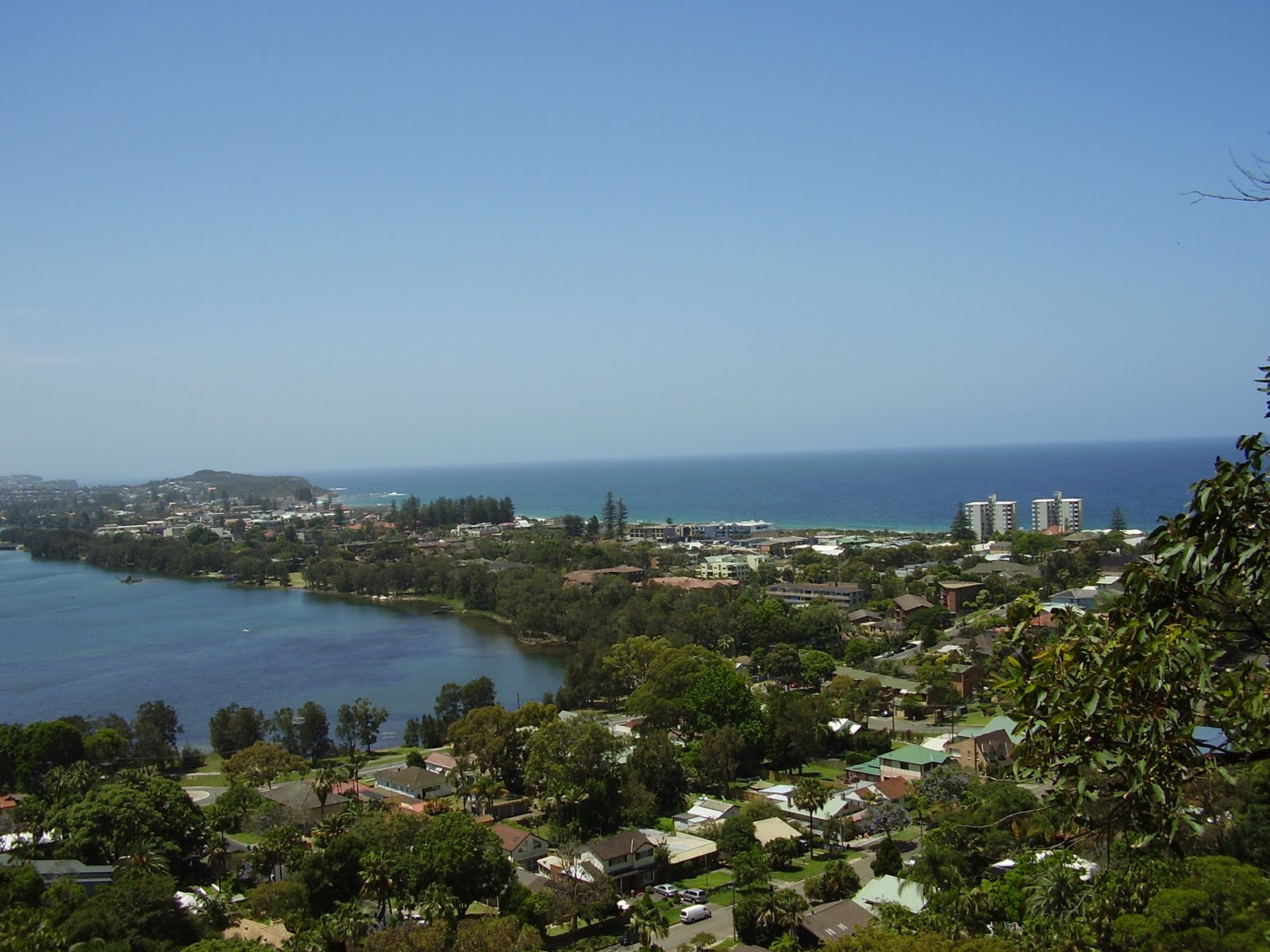
^ East: The next four photos, commencing with this one, were all taken from the lookout seen in the previous photo and should be viewed as a complete panoramic sequence looking south and reading left (east) to right (west). This first photo is looking due east, straight out to sea. Far below, the ocean waves break on the reef at the base of the cliff. Over the distant curve of the horizon is New Zealand. Beyond that, Chile.

^ South-East: The estuary, where the lake waters pass over the reef and empty into the ocean. Way off in the distance, across the water, can be seen Long Reef, as it stretches out into the Pacific Ocean. It was in Lancaster Crescent at Long Reef that George and I first met in February 1973, through a mutual friend. Long Reef holds so many wonderfully happy memories for me. On a more somber note, Long Reef is where my ashes will be scattered one day. They are to be cast upon the waters on the night of the full moon, as the moon rises out of the ocean and the tide rushes out to sea. But not yet!

^ South: The beautiful Narrabeen coastline. North Narrabeen in the foreground. South Narrabeen, where I grew-up, in the middle distance. Collaroy in the far distance. Long Reef off camera, to the left. It is said that everyone of a certain age knows exactly what they were doing when they heard of JFKs assassination. I’m no exception. I was on that stretch of golden sand in the immediate foreground when I heard. I was studying for my lifesaving certificate, practicing resuscitating a classmate. A fellow student rushed up to us on the sand, excitedly declaring, “Someone shot the American President”.

^ West: The Narrabeen Lake estuary, with the coastal waters of the lake visible beyond the Ocean Street bridge and causeway. The waters of the lake proper stretch off camera to the west. 

^ I take the wooden steps down to the lakeside path, which leads to North Narrabeen beach. From there I walk along the beach to South Narrabeen, where I grew up. This photo shows South Narrabeen beach, looking south towards Collaroy in the middle distance and Long Reef in the far distance, as seen from the end of Mactier Street,  the street where my childhood home was located. It’s still early, with few people out and about. The air is warm with a refreshing ocean breeze blowing. It was fun to paddle in the sea, as I walked along the beach. The water was quite cold and made my toes tingle.

^ I sit on the beach at the end of Mactier Street and gaze out to sea. If these sands could speak, oh what a tale they would tell. When one thinks of ghosts, the usual imagery that comes to mind is of haunted houses and graveyards. For me, however, here be ghosts! All of them friendly. This was my playground when I was a child. I spent much of my time here. As I sit here today, my parents and many other loved ones from my childhood are not far away. In fact, this apparently deserted beach is not deserted at all. I am surrounded by loved ones here today.

^ For example, here’s a little chap I know very well. His name is Kerry. He is a sensitive, shy, introspective child, who loves to splash and play in the sea. This photo of me was taken at the same place the previous two above photos were taken, on South Narrabeen beach at the end of Mactier Street.

^ I leave the beach and walk directly inland along Mactier Street, where my childhood home was once located. Our humble little seaside house was demolished long ago, to make way for apartments. I walk over the Mactier Street hill and pass by where my Aunty Glad, Uncle Eric and cousin Dorothy once lived, their house also sadly long since gone. Not far from the sea, I come to Narrabeen Lake. I walk along the lakeside path; the big, old, lichen-covered she-oak trees shading my progress. As a child, they reminded me of the apple-throwing trees from The Wizard of Oz. They still do.

^ I take a seat on a park bench, under the shade of the she-oaks, and gaze out over the tranquil waters of the lake. Ducks paddle close to shore. Memories come flooding back to me. This is only a short walk from my childhood home and I had many happy times playing here.

^ I leave the path and walk down to the lake shore. Ducks outnumber people at this early hour. As they glide past, they quack gently to each other, as if in hushed, conspiratorial conversation.  The barely perceptible, gently murmuring ebb and flow of the wavelets lap languorously at the shore. The air is moderately warm, carrying with it the distinctly subtle, fecund scent of lake water, mixed with the ever-present perfume of the eucalyptus trees.

^ As I walk back from the water’s edge, I appear to have attracted a cute, waddlesome entourage. I take a seat on a nearby park bench, open my knapsack, and share a banana sandwich with my new-found, feathered friends.

 The path leads me closer to the reed-beds at the lake’s edge, where the boughs of the she-oaks hang low. It was near here that an old boatshed once stood. We children would hire canoes and paddle off for a day of high adventure, our parents stressing that we must keep close to the shoreline. My maternal grandparents lived next-door to us. My father and grandfather would sometimes hire a row-boat from the boatshed and enjoy a day of fishing together on the lake.

^ The path leads away from the water’s edge and starts to climb through the dense undergrowth towards Collaroy Plateau. This short-cut to the summit is known only to locals, specifically local children. The increasingly steep, serpentine path meanders through the bush as the warmth of the sun shines down on my back. In time, the path gives way to steep steps, cut into the bedrock of the escarpment. 

^ A beautiful vista greets me at the top.

^ Narrabeen coastline, looking north. The headland in the distance is where I started my walk. I walked along the beach to Mactier Street and then walked inland to the lake. In the foreground, to the left of this picture, near the lake’s edge, can be seen a traffic roundabout. That’s Mactier Street, where I was raised. My family lived at the ocean end of the street, to the right, off camera. In 1770,  Captain James Cook sailed up the coast here, as he charted the Australian east coast in his ship, His Majesty’s Barque Endeavour. Cook claimed the east coast under instruction from King George III of England on 22 August 1770, naming eastern AustraliaNew South Wales”.

^ Captain James Cook RN, 1728–1779

^ Long before the arrival of Captain Cook, there lived on the banks of this lake an Aboriginal princess named Narrabeen. In the local Aboriginal dialect, the word Narrabeen means “Swan”.  At school, we were taught the legend about the heroic young woman, Narrabeen, who ran to seek help from friendly neighbours, when her people were under attack from a hostile, invading tribe. Narrabeen, the seaside suburb of Sydney, is located approximately  23 km (14 miles) north of the city.

^ And so I walk back to North Narrabeen via Ocean Street and pick a lovely bunch of George's beautiful roses from his garden (He said I could!) before driving home to Sydney's Inner West, where I live. The roses look stunning on my coffee table.